Saturday, 1 October 2016

Days 83-84 (24-25 Sep) All About Albany

Aiming for somewhere to stay slightly out of town, we settled on a little caravan park in Frenchmans Bay. It was slightly eccentric, mostly accommodating long-term tenants, but the tiny facilities were exceptionally clean and the scenery gorgeous. Situated in the lee of a bay, its postcard wooden jetty accommodates anglers in the early morning before a large squadron (yes, it's a squadron!) of preening pelicans move in to take possession of it a little later. Dave enjoyed having a sunset photography spot right outside the caravan door – which would have been perfect if the sun had actually shone.
Jetty at Frenchmans Bay

Jetty by night, looking towards Albany city

A Squadron of Pelicans, Frenchmans Bay
A new attraction opened here just a few months ago – The Gap and Natural Bridge. The Gap entails a marvellous feat of engineering, a walkway cantilevered some 40m over a huge narrowing rock chasm (the Gap) where the ocean channels through beneath, sending impressive plumes of sea spray skywards. Or in this case, feetwards, right underneath us.

The Gap, Albany

The Gap, Albany

The Gap, Albany

The Natural Bridge, Albany

Rearranged letters (Liz)
A bit further down the road we visited the Blowhole, which, despite the wind, was so impressive (not) that Dave nearly walked right over the top of it without realising. Not that that is an unusual occurrence, I’m often yelling “stop” on our walks to prevent him treading on a snake or lizard.
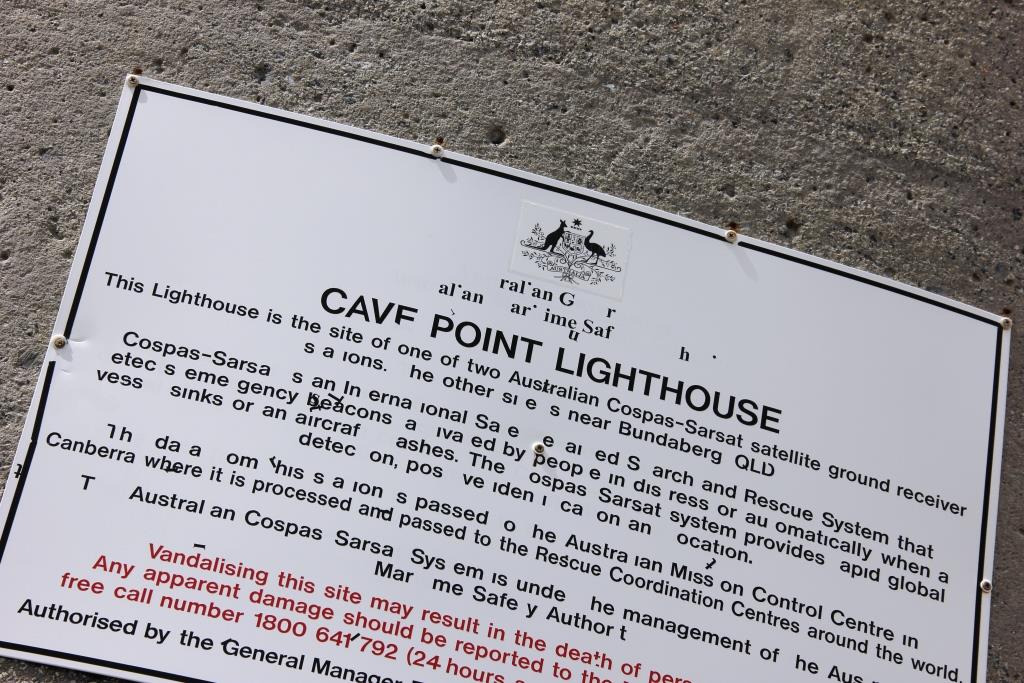
The nearby Cave Point Lighthouse stands on such a windy point that even the letters on the signs have rearranged themselves (see right). 

Lights in lighthouses are a bit passé these days. The beacon here has been replaced with satellite technology – it has a radio receiver for emergency response signals from vessels in distress. Nearby we were thrilled to see a large pod of dolphins – up to 15 – hunting  back and forth in the shallows of the bay.
Hunting dolphins, Cave Point (Liz)

The coastline is so rugged and wild down here the Council doesn’t know which warning signs to put up, so outdoes itself in graphic signage (as shown below). I'm sure not how we got out alive, but we did.

Coast warning, Cave Point

A huge rock - estimated to weigh 100 tonnes - has washed ashore on one of the beaches, giving some idea of the strength of the southern coast. I suspect Albany hasn’t been washed away because it stands on a bedrock of solid granite. A signature characteristic of this city is the large boulders the size of houses that crop up everywhere; dwellings and roads are just built around them. There are countless interesting rock formations in this region. We visited the famous Elephant Rocks, which, incidentally, really stank – not unlike a dead elephant – and watched with interest as a lady considered a little ocean bathing. Despite the sunshine, the wind was bitter and the water freezing. 
“It’s so cold!” she said.
“Well, nothing between us and Antarctica here” I laughed.
“Really?” she said. Um, yes, really.
Do they look like Elephant Rocks to you?

Elephant Cove

Elephant Cove

Elephant Cove / William Bay

Elephant Cove/William Bay

On Saturday we were off to Discovery Bay – a tourist destination on the peninsula with an old whaling station, wildlife park and botanical gardens. We spent five hours there, but needed six or seven (they kicked us out at closing time). We got to crawl all over the Cheynes IV, a genuine old whaling ship now run aground for tourist tours. In addition to the rigours of whale hunting we learned that you should never insult the ship cook’s food (you’ll have a meat cleaver hurled in your direction), and to stand clear of the coiled harpoon cable when it is fired (one poor guy lost his lower leg due to standing in the wrong place). We greatly enjoyed the sea discovery films (including 3D) and a warehouse of huge whale and other sea creature skeletons.
Onboard the Cheynes IV, Discovery Bay

Cheynes IV, Discovery Bay

Blue whale skeleton, Discovery Bay

Dolphin skeletons, Discovery Bay
Over at the wildlife park we met a koala called Frank, rescued from being mauled by three dogs; he consequently has no ears. So you can actually call him whatever you want, he can’t hear you. There were at least six white boomers, but they won’t be racing Santa Claus through the blazing sun, because they get sunburned too easily. We were also intrigued by the bush stone-curlew, also known as the “screaming woman” bird; its eerie wailing from the bush has caused many people to phone the police.
Woylie / Brush-Tailed Bettong

Sunburned white boomer (kangaroo with a rare condition known as leucism; reduced pigmentation)

Frank the koala. Don't talk about the ears.

Curlew "screaming woman" bird; male protecting a nesting female

Tawny Frogmouth

'Allo allo

Another white boomer
 School holidays commenced this weekend, and the population at tourist sights was exploding. Back in Albany we did the rounds of the Heritage Park and watched the downhill mountain bikers commence their runs from the top of Mt Clarence, the main roads through town being cordoned off for this event. This military memorial park looks out over the King George Sound, the point from which allied Navy ships sailed during the war, Albany being their last view of Australia as they departed for distant shores. The historic military battlements retain the impressive guns installed to protect this strategic harbour during World War II. Only one shot was ever fired in anger – at an errant Dutch ship – but this warning shot across the bow fell embarrassingly short of its target and apparently didn’t frighten the naughty Dutch sailors at all.
Australia & New Zealand Memorial - The Great War, Albany

Mountain bikers awaiting their turn - top of Mt Clarence, Albany

Gun placement, Heritage Park Albany

Being out of town at Discovery Bay on Saturday, I had difficulty obtaining a copy of the Weekend Australian on Sunday. The supervisor in Coles condescendingly advised me “it came out yesterday”. I gritted my teeth and restrained from informing her of the definition of “weekend”, or pointing out the dozens of copies of the Weekend West Australian still stacked on the shelves right next to us. I get the distinct feeling she knew I was from the east coast, and does not think much of people from there. Don’t worry, lady, the wise men came from the east, and we’re heading back there.
Sunset, Frenchmans Bay

Sunset, Frenchmans Bay

Frenchmans Bay

Frenchmans Bay

Cheynes II wreck, Quaranup
The Old Farm, Strawberry Hill - Albany (Liz)

The Old Farm, Strawberry Hill - Albany (Liz)


Friday, 30 September 2016

Days 79-82 (20-23 Sep) Land of the Giants from Heel to Toe

Rays at Leeuwin Cape
Glance at the bottom left hand corner of Australia, where that foots kicks out in the “heel” position of the heel & toe polka. We have just waded our watery way from Augusta (the big toe) through to Albany at the southernmost point of WA (the heel) via Pemberton, Northcliffe and Walpole. Names invariably derived from European explorers and settlers. There are also many places down here with indigenous names such as Yallingup, Cowaramup, Quindalup, Nannup… Whazzup with that? Apparently “up” means “place of” in local indigenous dialect.

Let’s start with Augusta – right at the base the big toe. It was great weather for ducks. Such great weather that we observed a pair at the Augusta caravan park herding no less than 16 ducklings, who, fortunately for the parents, all seemed very obedient. I’m astounded a duck could even sit on so many eggs at once, let alone successfully hatch them. The damp weather was a good excuse to drive through north through the enormous Karri forests lush with wild wisteria and more arum lilies, and south down to Cape Leeuwin.
Ducklings at Augusta

Augusta pond

Driving through forests, South West Cape

Water laden roadsides, South West Cape

Wind swept tree, South West Cape
The indigenous name for Pemberton is Wandergarup - place of plenty of water. Most apt. It even rained inside when a previously undiscovered self-cleaning mechanism of the caravan suddenly burst into action. The kitchen tap nozzle achieved blast off due to air and water pressure in the hose, spraying a jet of water clear across the interior of our small van where I was directly in the flight path. It is not safe to remove your raincoat even inside down here.

Pemberton is a truly picturesque little village built completely of timber, named after Pemberton Walcott, who was part of an expedition party to the region in 1861. His preferred name for the town was Walcott, vetoed by the Post Office because he already had Port Walcott named after him. So Pemberton it was. Being a rather unblokey name, I can’t imagine “Pemberton” being used too often down here. What did his mates call him? Pem the Pom? Bert? But from this we learn that it is good to bestow upon your children a distinctive Christian name so that at least 2 towns can be named in their honour.
Cascades, Pemberton

Pemberton Village
Despite the late Pemberton Walcott being mostly forgotten, his town still boasts some remarkable features – the giant Karri trees. Living for 300-500 years and growing more than 75 metres high, they doubled as lookout towers for spotting bushfires back in the day. Long spikes embedded into the trunk spiral upwards to a viewing platform more than 50 metres up. Brave souls without heart conditions can still experience the climb. Most common souls are overcome with fear and vertigo after about 15 spikes. We visited the Gloucester tree. After watching a few climbers – successes and failures - we attempted a short distance upwards to get in the spirit of things, but decided we could do without that kind of rise in blood pressure. No one has actually died climbing the trees, but several people have had heart attacks after doing so. Many more need to be talked down after freezing in fear at the top like the proverbial kitten who climbed too high.

Walk Through Tree, Pemberton

Liz a little way up the Gloucester Tree, Pemberton
We passed through Northcliffe with a quick stop at the Visitor’s Centre for the Understory walk – a beautiful forest path with a series of art installations. A fire swept through a few years ago and left some ghosts in the trees; you may spot them in the pictures. We were unexpectedly detained here when we discovered four kangaroo joeys inside the tourist info centre. Their wildlife carer was looking for people to pat them as stranger orientation in preparation for the upcoming school holidays. We selflessly sacrificed half an hour to civic duty for the children by patting and cuddling joeys. Dave now wants a pet joey when we return home. We haven’t yet negotiated who will be doing the 4-hourly feeds overnight.
Dave & joey

2 month old joey (Liz)

Holding hands
Understory art walk, Northcliffe (Liz)

Understory art walk, Northcliffe (Liz)

Understory art walk, Northcliffe (Liz)
We finally tore ourselves away from those big brown joey eyes pleading for more pats and headed for Walpole, which was the original name of this township before it changed to Nornalup. Which is also the name of a place down the road – a cause of great confusion back in the ’30s. Walpole was always the preferred name, but that pesky Post Office wouldn’t permit it; some bureaucrat believing there was already a Walpole township in Tasmania. There was not. This was finally confirmed, and Walpole got its name back. Despite such an identity crisis in its childhood, the town is now firmly established as the home of the ancient giants – old growth red tingle and karri trees. The most famous tourist attraction is the Valley of the Giants Treetop Walk – a walkway suspended more than 40 metres high through an old growth forest. Exhilarating, but also a little motion sickness inducing due to the rhythmic swaying of the metal walkway as people moved along it – some, with all the grace of an elephant.
Giant Red Tingle, Nornalup

Giant TreeTop Walk, Nornalup
Last but not least, we climbed Mt Frankland, which is actually a huge solid granite rock. Still raining and late in the day, with cloud shrouding the summit, we had the place to ourselves. We donned raincoats to do the walk and climb the final 300 stone steps which come with a warning – “Do not climb if faint of heart or foolhardy!” We were rewarded at the top with the sun breaking through the clouds, and a full rainbow appearing. Dave’s last word on the matter: ‘“There’s no point in climbing!” she said. “You won’t be able to see anything anyway!” she said.’

There will be no getting out of any future walks now, whatever the weather.
Mt Frankland
Cape Leeuwin Lighthouse

Tuesday, 27 September 2016

NEWS FLASH - WEATHER REPORT – 27 September 2016

We interrupt our usual broadcast to bring you a weather report.

We are currently in Esperance (Tuesday) and the wind is howling and rain falling. A low pressure system is building here, set to intensify as it moves east tonight and slams into the west coast of South Australia within the next few days.

We were treated to spectacular skies of the building storm front as we moved out of the Stirling Ranges in south-west WA today, heading east to Esperance. We were also treated to occasional squalls and a wicked tailwind that gave us good progress.

However, this monster Low pressure system is expected to bring with it the strongest winds that South Australia has had in 50 years – right where we are headed. Rain up to 100mm by this weekend is expected to cause flash flooding in parts of the State.

The land here is already completely sodden after a winter of heavy rains, with much water on the roadsides and in paddocks. Fields of crops are looking magnificent, but many farmers further east are likely to have their properties underwater within the week, and crops lost.

We plan to slow our progress and watch what happens with the storm front ahead of us, but please pray for many facing significant losses across South Australia in the next few days.


Storm front, 27 Sep 16, The Lily Dutch Windmill, Amelup WA

Storm front over the Stirling Ranges & canola fields, WA, 27 Sep 16


Saturday, 24 September 2016

Days 76-78 (17-19 Sep) A Land Flowing with Wine & Chocolate

Margaret River! The promised land, flowing with milk (exotic ice-cream) and honey (truffle infused), but more importantly wine, chocolate and cheese. The cradle of world-class produce, we can see why everyone up north – and from all over Australia, really - salivates and swoons at the very mention of this region. The sparse wilderness which dominates the majority of Western Australia suddenly transforms into lush green fields, huge tree forests, vineyards and orchards.

Because we had been transported into some sort of paradise in Margaret River, we somehow ended up with a private ensuite on our caravan site there as well. Which was great when it rained at night.
Margaret River has 215 vineyards and 187 wineries. It has 5 chocolate factories, and countless other providores selling all manner of fine fare. How to choose just a few to visit? The Berry Farm was recommended; an excellent choice, as I got to sample up to 6 of their fruit wines and liqueurs. Let me know if you want to sample the blackberry liqueur which pairs well with dry champagne on our return; I’ve already booked Joce in for this. We also watched feeding time at the huge bird enclosure which doubles as an orchard; the chickens share their quarters with ducks, peacocks and even an emu, who very much looks as though he is still wondering whatever happened to his life.

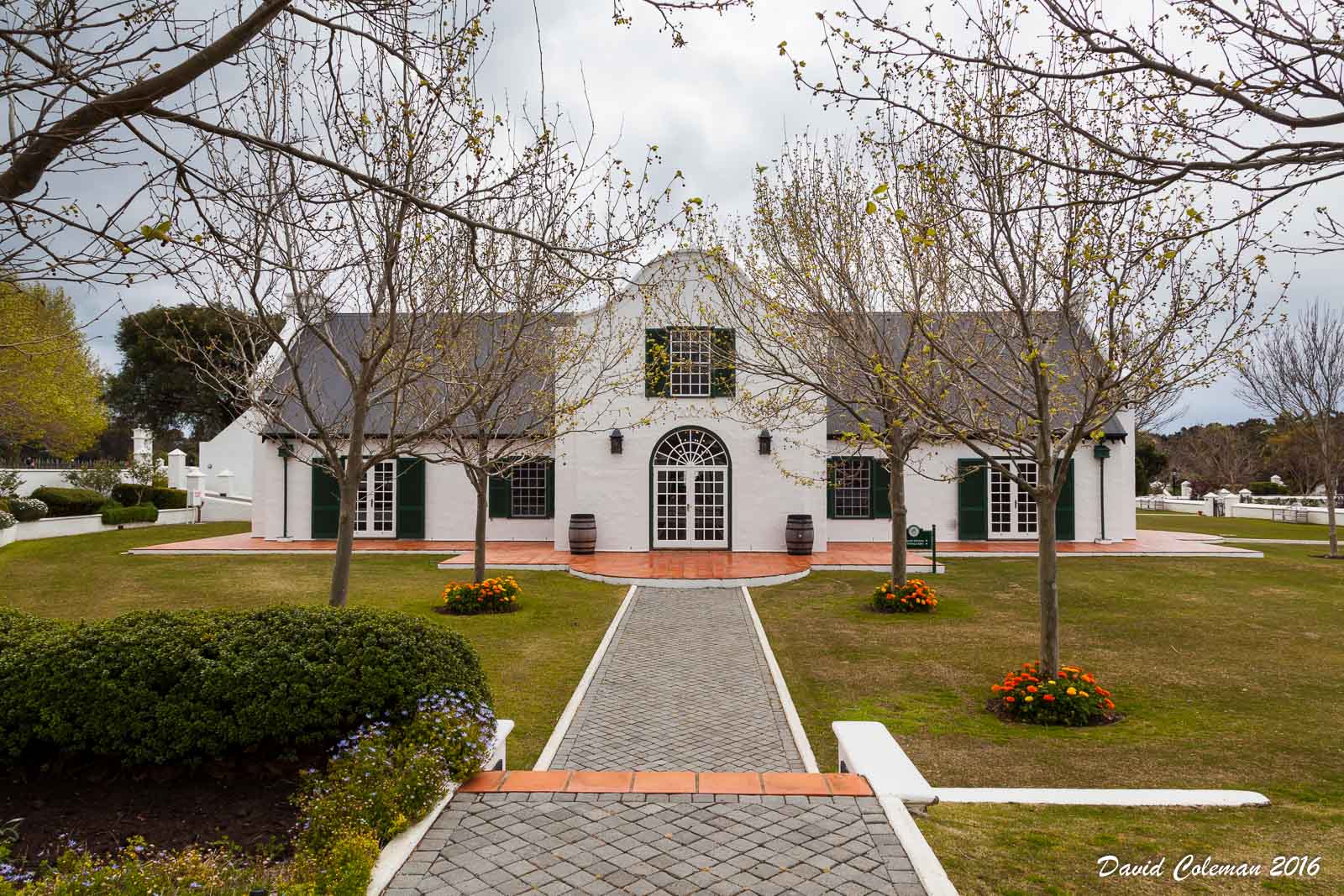
You must understand that the wineries down here are lavish, capital L. We wanted the full experience, so picked Voyager Estate, which comes with extensive formal gardens. They do 3 and 6 course gustation lunches, but we opted for the cheese platter and bread plate, curling up near the indoor open fire with a wine flight of 3 (Liz), while the wind blew and rain fell outside. Happiness with a capital H.

Driving around Margaret River we were intrigued by what looked like historic ruins down by the river, and, in usual Dave style, went crashing through the bush looking for this elusive building. Even more intriguingly, once we found it, the buildings were indeed historic (a Victorian Georgian mansion), and destroyed by fire, but the very elaborate and extensive gardens were in immaculate condition. A private gardener spotted us and immediately ordered us to leave. We later learned we had stumbled upon a certain private estate lost in a fire some years ago – a controlled burn that was apparently not so controlled. Its future remains very uncertain.

Chocolate – we picked the Gabriel chocolate place, because we know a nice guy by that name back in Canberra. Their chocolate berry brownies - superlative. Gabriel would definitely have enjoyed them too.

Talking about desserts, we managed to get ourselves invited for supper to the home of Carmelo, owner of Edible Art in Margaret River, award-winning cake maker, who also just happens to have cooked dessert for the Queen. No, I’m not making this up (he’s also a descendant of a famous Sicilian Mob family, but that’s a whole other story). We met Carmelo and his lovely family at the Margaret River Baptist church and were even more delighted to discover – through Facebook – that we already had friends in common.

We visited the magnificent coastline, took hundreds more pictures of the noxious arum lilies, fields of flowers, vineyards and winding walking trails and – well – you have to come visit it yourself. We’ve provided some photos to whet your appetite. Don't get jealous, get travelling.


For those who have been concerned about Dave’s toes – they are improving significantly, and looking much better. He is on his 5th (!) lot of antibiotics, so we’ll see what happens. He has now seen 4 doctors in 3 months, more than he usually sees in 3 years. This trip will officially go down in the record as The One Where Dave Got Sick (not Liz). Although we still have 2 weeks to go…
Voyager Estate gardens (Dave)

Voyager Estate (Dave)

Voyager Estate (Liz)
You know what this is, I won't rub it in (Dave)

Abandoned home (Dave)
Lilies in a field (Dave)

Isaacs Rock at Sunset (Dave)
Jetty at Canal Rocks (Dave)

Pretty much every road in Margaret River looks like this (Dave)

Vineyard (Dave)
Birds of different feathers flock together and seem to get along (Liz)